
An implantable contact lens (ICL) is the main alternative to laser eye surgery for people whose prescription is too high, whose corneas are too thin, or whose eyes are too dry for LASIK. Because it is surgery inside the eye rather than on its surface, the first question most people ask is whether it is safe.
The short answer is yes, for suitably selected eyes, and the long answer is worth reading: the published evidence is reassuring, the risks are real but well understood, and the lens can be removed if it ever needs to be. This guide covers what an ICL is, who it suits, what the ten-year studies show, how the procedure and recovery work, how it compares with laser surgery, and what it costs at Focus Vision in Brisbane.

What is an implantable contact lens?
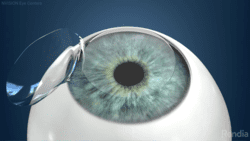
ICL stands for Implantable Collamer Lens. It is often called an implantable contact lens because the result is similar to wearing a contact lens, but nothing sits on the surface of the eye. The lens is a thin, flexible implant placed in the posterior chamber of the eye, behind the iris and in front of your natural lens (AAO EyeWiki). It stays there permanently, correcting your prescription the way a contact lens would, without anything to clean, replace or feel.
Collamer, the lens material, is a copolymer of collagen and a hydrophilic plastic (HEMA) with a built-in ultraviolet absorber, developed for its compatibility with the eye (FDA, 2022). The current EVO lens has a small central port that lets fluid circulate through the lens, which removed the need for the laser iridotomy that earlier models required (Packer, 2018).
Who an ICL suits
ICLs are usually recommended when laser eye surgery is not the best option:
- High prescriptions. The lens is approved to correct short-sightedness from −3.0 D up to −15.0 D and to reduce it up to −20.0 D, (FDA, 2022), and the toric version used in Australia corrects up to 6 D of astigmatism at the same time. Hyperopic (long-sighted) ICLs are available in Europe and Australia in powers from +3.0 D to +10.0 D (STAAR Surgical).
- Thin or irregular corneas. Because no corneal tissue is removed, the cornea’s strength and shape are untouched (Clin Ophthalmol review).
- Dry eyes. LASIK cuts corneal nerves and can worsen dryness; an ICL does not touch them, and comparative studies of high myopia report better optical quality after ICL than after LASIK for that reason (ICL versus LASIK study).
- People who want a reversible option. The lens can be exchanged or removed.
To be eligible you need to be an adult with a stable prescription, a healthy eye and enough space inside the eye for the lens. The approval requires an age of at least 21, a refraction that has changed by no more than 0.5 D, and an anterior chamber depth of at least 3.0 mm, which is measured at your assessment (FDA, 2022). The original approval ran to age 45; in February 2026 the US indication was extended to 60 (STAAR Surgical). In practice the upper limit is set by the health of your natural lens, because once early cataract changes begin, lens replacement is the better operation. Glaucoma, cataract and certain other eye diseases rule an ICL out.
Are they safe? What the evidence shows
The overall picture is good. A review of 67 preclinical and clinical studies, covering effectiveness data on 1,905 eyes and safety data on 4,196 eyes, found the central-port ICL safe and effective for the correction of myopia (Packer, 2018). A 10-year follow-up study of ICL implantation for myopia and myopic astigmatism reported no vision-threatening complications and good outcomes for safety, efficacy, predictability and stability across the decade (10-year ICL follow-up, Am J Ophthalmol 2019).
The risks are specific and known. Because the lens sits close to your natural lens, it can contribute to cataract forming there over the years; the cornea’s endothelial cells, which keep the cornea clear, are monitored because they can decline slowly (a mean loss of 5.3% over ten years in the follow-up study, with eye pressure unchanged over the same period) (10-year ICL follow-up, Am J Ophthalmol 2019); and the lens must be sized correctly so that it sits at the right height above your natural lens, which is why the measurements at your assessment are repeated with several instruments (Clin Ophthalmol review). Dislocation after a blow to the eye is very rare, at 7 of 9,775 eyes in a multicentre survey, but five of those seven happened during sport, so protective eyewear is still recommended for ball and contact sports (ICL dislocation survey, PLoS One 2022).
That is why aftercare is not optional. Your follow-up visits check the eye pressure, the position of the lens (its “vault” above your natural lens), the clarity of your natural lens and the health of the corneal endothelium. An ICL is a lifetime commitment to regular eye examinations, and in return the lens itself does not degrade over time (FDA, 2022).
ICL versus laser eye surgery
| ICL | LASIK, TransPRK, CLEAR | |
|---|---|---|
| Where the correction happens | A lens placed inside the eye | The cornea is reshaped with a laser |
| Corneal tissue removed | None | Yes |
| Reversible | Yes, the lens can be removed or exchanged | No |
| Suits thin corneas | Yes | Often not |
| Suits very high prescriptions | Yes, to −20 D | Limited at the top of the range |
| Effect on dry eye | Corneal nerves untouched | Can worsen dry eye, least so after CLEAR |
| Long-term monitoring | Lifelong checks of pressure, lens position and cataract | Routine eye checks |
Neither approach is better in general. For most prescriptions laser eye surgery is simpler and cheaper; for high prescriptions, thin corneas and dry eyes the ICL is often the safer choice. The assessment shows which applies to you, and Focus Vision offers both, so the advice is not shaped by what the clinic can do.
The procedure, step by step
- Assessment and measurements. Your prescription is confirmed and the shape and internal dimensions of your eye are measured, including the anterior chamber depth and the width of the eye, which determine the lens size. Sizing is the single most important step, which is why it is done with several instruments and repeated.
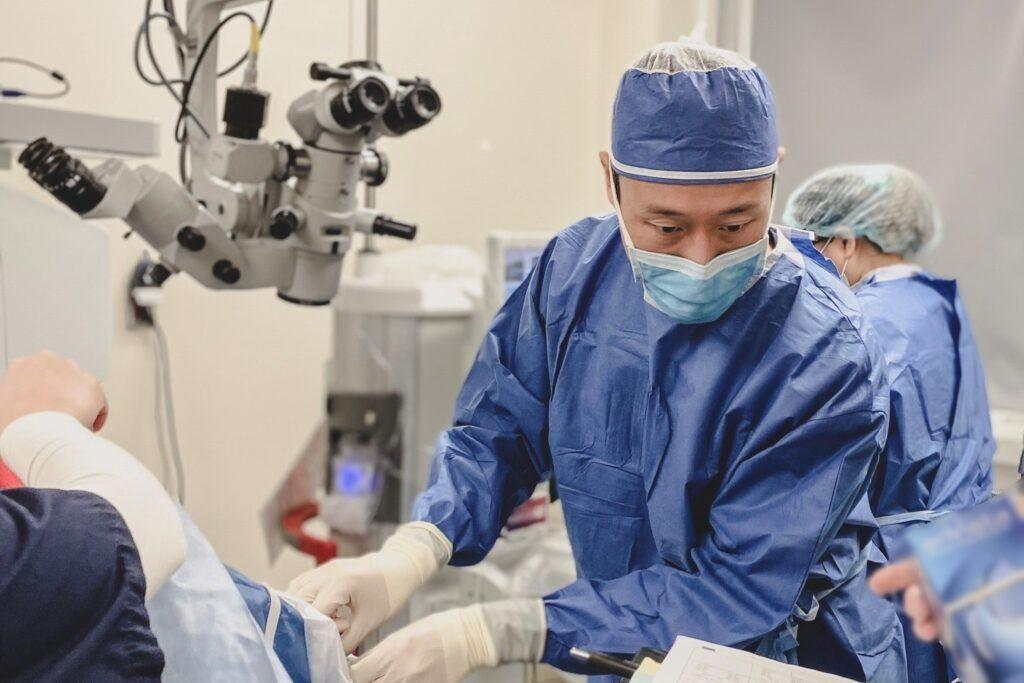
- The day of surgery. ICL implantation is day surgery at Focus Vision under local anaesthetic with sedation, so you are relaxed and comfortable but not under general anaesthetic. The anaesthetist’s fee is included in the price.
- Placing the lens. The surgeon makes a small, self-sealing incision at the edge of the cornea, folds the lens, slides it into the eye and unfolds it behind the iris, in front of your natural lens. No stitches are needed. The procedure takes about 15 to 30 minutes per eye.
- Straight afterwards. Vision is usually noticeably clearer within 24 to 48 hours, and most people are back to normal activities within a few days.
Recovery and aftercare
- Use the prescribed antibiotic and anti-inflammatory drops exactly as directed.
- Expect mild dryness, light sensitivity or slight blur in the first few days; this settles.
- Avoid rubbing the eye, and avoid swimming, heavy exercise and anything that strains the eyes for about a week.
- Wear protective eyewear for ball and contact sports.
- Attend every follow-up visit. Early visits confirm the eye pressure and lens position; later visits, for life, watch for cataract and monitor the corneal endothelium.
Results and how long they last
ICLs are designed to be permanent. In the 10-year study, 71.4% of eyes were within 0.5 D and 87.1% within 1.0 D of the intended correction a decade after surgery, with stable refraction and a stable endothelium (10-year ICL follow-up, Am J Ophthalmol 2019). Because the cornea is untouched, the optical quality of the eye is preserved, and studies comparing ICL with LASIK for high myopia report fewer induced higher-order aberrations after ICL (ICL versus LASIK study). If your prescription changes years later, the lens can be exchanged; if you develop a cataract, it is simply removed at the time of cataract surgery.

What it costs in Brisbane
ICL surgery at Focus Vision is $7,000 per eye, including the anaesthetist, the lens, hospital and theatre fees, all pre-operative assessments and a year of follow-up appointments; prescribed medications and eye drops are extra, and the price does not rise with your prescription. Interest-free plans over 24 months start from $68 a week. Medicare does not cover ICL surgery performed to correct a refractive error. The live price list, and a comparison with other Brisbane clinics, is on our costs page. The paid specialist surgeon consultation fee is deducted from the surgery price for every procedure if you proceed. Prescribed medications are purchased separately so eligible patients can use PBS subsidies for eligible prescriptions; see our pricing details.
Get in touch
If you have been told your prescription is too high or your corneas too thin for laser, an ICL assessment will tell you whether it is the right option. Call us on (07) 3239 5005, email hello@focusvision.com.au or book a free optometrist assessment.
References
- U.S. Food and Drug Administration. EVO/EVO+ VISIAN Implantable Collamer Lens (EVO ICL) for Myopia. PMA P030016/S035 approval labeling, 2022. accessdata.fda.gov/cdrh_docs/pdf3/P030016S035C.pdf
- American Academy of Ophthalmology. Phakic Intraocular Lenses. EyeWiki. eyewiki.org/Phakic_Intraocular_Lenses
- Packer M. The Implantable Collamer Lens with a central port: review of the literature. Clin Ophthalmol. 2018;12:2427-2438. doi:10.2147/OPTH.S188785. pubmed.ncbi.nlm.nih.gov/30568421
- Posterior Chamber Phakic Intraocular Lens Implantation for the Correction of Myopia and Myopic Astigmatism: A Retrospective 10-Year Follow-up Study. Am J Ophthalmol. 2019. pubmed.ncbi.nlm.nih.gov/31078536
- Intraocular Implantable Collamer Lens with a Central Hole Implantation: Safety, Efficacy, and Patient Outcomes. Clin Ophthalmol. doi:10.2147/OPTH.S379856. pmc.ncbi.nlm.nih.gov/articles/PMC10046236
- Multicenter survey on implantable collamer lens dislocation. PLoS One. 2022. doi:10.1371/journal.pone.0264015. pubmed.ncbi.nlm.nih.gov/35157743
- Optical and visual quality comparison of implantable collamer lens and femtosecond laser assisted laser in situ keratomileusis for high myopia correction. PMC8077018. pmc.ncbi.nlm.nih.gov/articles/PMC8077018
- STAAR Surgical. CE Mark Approval for EVO Visian ICL (news release), 2020. staar.com
- STAAR Surgical. FDA Expands U.S. Age Indication for EVO ICL. Press release, 17 February 2026. investors.staar.com
Start with a free optometrist assessment to explore your suitability. Every patient proceeding to surgery then has a paid consultation with a specialist surgeon to confirm suitability, discuss their procedure and plan surgery. The consultation fee is deducted from the surgery price for every procedure. See consultation and pricing details.