
Short answer: Cataract surgery and lens replacement (refractive lens exchange) are among the safest and most successful operations in medicine, but like any surgery they carry risks. The most common problems, such as dry eye, glare and later clouding of the capsule, are temporary or easily treated. Serious complications are uncommon: infection inside the eye happens in about 6 in 10,000 operations (Shi et al., 2022) and retinal detachment in about 1% over the first 4 to 5 years (Daien et al., 2015). A tear in the lens capsule during surgery happened in 1.95% of operations in a UK national study from 2006 to 2010 (Day et al., 2015); in our own audit at Focus Vision, it happens in about 1 in 1,000.
Watch: the risks of cataract and lens replacement surgery
This is the consent video we ask you to watch before cataract surgery or lens replacement. It covers the important risks of the operation, so you can ask your surgeon about anything that worries you.
Is cataract surgery safe?
Yes. In our own audit at Focus Vision, 99.5% of eyes without other eye disease reached the legal driving standard (6/12 or better) after surgery. As a published benchmark, a UK national study of 180,114 cataract operations found 94.6% of eyes without other eye disease saw 6/12 or better afterwards (Day et al., 2015). Most problems that do happen are minor and short-lived, and most of the serious ones can be treated if they are found early.
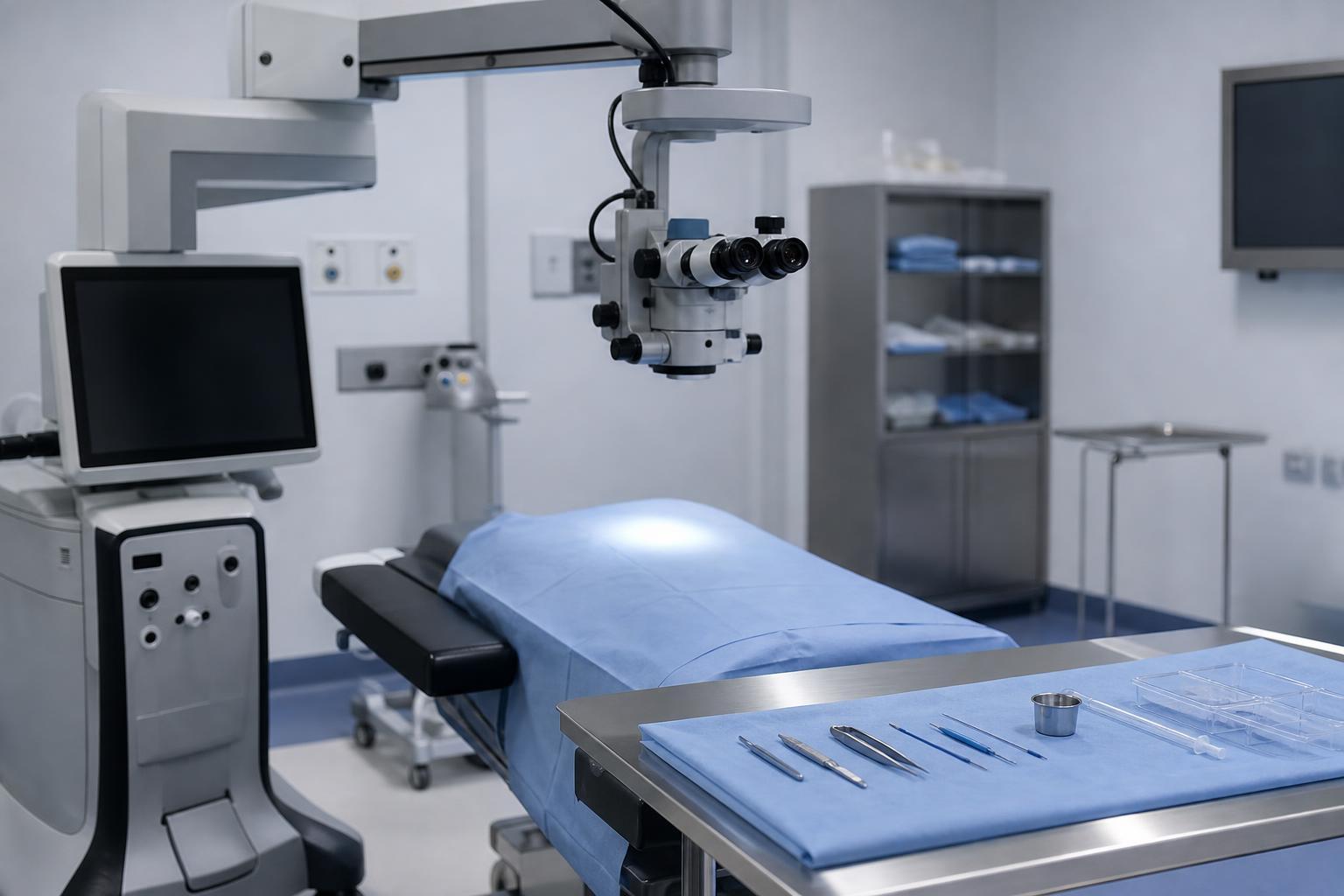
The risks below are averages from large studies. Your own risk depends on your eyes and your health, and your surgeon goes through it with you before you decide.
Risks at a glance
| Risk | How often | What it means |
|---|---|---|
| Dry eye | Almost everyone, for a few weeks | Fluctuating vision and tired or watery eyes; settles over 8 to 12 weeks with lubricating drops |
| Raised eye pressure in the first hours | About 1 in 5 eyes in one small study | Usually short-lived; checked after surgery and treated if needed |
| Glare, flicker or a dark crescent at the edge of vision | About 9% in one trial, mostly temporary | Usually fades over weeks to months |
| Halos with EDOF or multifocal lenses | Common at first | Usually less bothersome over the first months |
| Leftover prescription | A UK benchmark expects 85% of eyes within 1 dioptre of the target | Glasses, or free laser fine-tuning at Focus Vision |
| Toric lens rotation needing repositioning | About 1.6% | A short second procedure to turn the lens |
| Swelling at the back of the eye (macular oedema) | About 1.2% without risk factors | Blurs vision a few weeks after surgery; treated with drops |
| Posterior capsule rupture | 1.95% in a UK national study (2006 to 2010); about 1 in 1,000 in our own audit | Usually managed during the same operation; raises other risks |
| Retinal detachment | About 1% over 4 to 5 years | Needs urgent surgery; higher in younger, short-sighted eyes |
| Infection inside the eye (endophthalmitis) | About 6 in 10,000 | Needs urgent treatment; the antibiotic we inject at surgery lowers the risk |
| Cloudy capsule later (PCO) | About 37% of under-65s within 10 years | A quick, painless YAG laser, free at Focus Vision |
Common and usually temporary
Dry eye
Almost everyone gets some dry eye after cataract surgery, and the tear film can stay disturbed for up to three months (Ta et al., 2025). It rarely feels “dry”: instead your vision fluctuates, your eyes feel tired or they water. Lubricating drops settle it. See cataract surgery recovery.
A rise in eye pressure
Eye pressure often rises for a few hours after surgery. In one study of uncomplicated operations, it spiked in 1 in 5 eyes 2 to 3 hours afterwards and had mostly settled by the next day; people with higher pressure beforehand were more likely to have a spike (O’Brien et al., 2007). It is usually short-lived, and if it needs treatment, drops or tablets bring it down. Keep using any glaucoma drops you already take.
Glare, flicker and shadows
A flickering light or a dark crescent at the edge of your vision (dysphotopsia) is common in the first weeks. In a trial of 320 eyes, 9% noticed a dark shadow, and in most it was temporary (Sharma et al., 2021).
Halos with EDOF and multifocal lenses
Lenses that give a range of vision, such as EDOF and multifocal lenses, split or stretch light, so halos around lights at night are more noticeable. They usually become less bothersome over the first months as your brain adapts (Rampat & Gatinel, 2021). We talk this through when you choose your lens.
Your result isn’t exactly as planned
A leftover prescription
Lens power is calculated from detailed measurements of your eye, but every eye heals slightly differently. A UK benchmark expects 85% of eyes to finish within 1 dioptre of the target and 55% within 0.5 dioptres (Gale et al., 2009). Our surgeons audit their own results against these benchmarks (see how to audit your cataract surgery refractive outcomes).
If a small prescription remains, you can wear glasses for some tasks, or have laser fine-tuning, which is free for two years under our enhancement policy.
A toric lens that rotates
Toric lenses correct astigmatism and have to sit at a precise angle. Occasionally one rotates in the first days or weeks. In a series of 993 toric lenses, 1.6% needed a short second procedure to turn the lens back into place (Hu, 2023).
Uncommon but more serious
Posterior capsule rupture
Your new lens sits inside the thin, clear capsule that held your cataract. Rarely, this capsule tears during surgery. In the UK national study, a tear (with or without loss of the gel behind it) happened in 1.95% of operations, and it was linked to a higher risk of retinal detachment and infection afterwards (Day et al., 2015).
In our own audit at Focus Vision, posterior capsule rupture happens in about 1 in 1,000 operations. Our formal results are being prepared for publication.
If the capsule does tear, it is usually managed during the same operation, and the lens can still be placed securely. Sometimes a further procedure is needed.
Swelling at the back of the eye (macular oedema)
Fluid can build up in the centre of the retina a few weeks after surgery and blur your vision. In a UK study of nearly 82,000 eyes, it occurred in about 1.2% of eyes with no risk factors, and was more common in people with diabetes (Chu et al., 2016). It is treated with drops and usually settles.
Retinal detachment
The retina can come away from the back of the eye after lens surgery. In a French national study of more than 2.6 million operations, the risk was 0.99% at 4 years. It was higher in people aged 40 to 54 (about 5 times the risk of those over 75), in men, in highly short-sighted eyes (about 6 times), and after a capsule tear (Daien et al., 2015).
A sudden shower of new floaters, flashes of light, or a shadow or curtain across your vision needs checking the same day. Treated early, most detachments can be repaired.
Infection inside the eye (endophthalmitis)
This is the most serious complication, but it is rare. A meta-analysis of nearly 5.9 million operations found a rate of about 6 in 10,000 in studies since 2010 (Shi et al., 2022).
To lower the risk, we inject an antibiotic into the eye at the end of the operation. In a European trial of more than 16,000 operations, leaving this injection out was linked to about five times the risk of infection (ESCRS, 2007). Infection usually shows up in the first week or two as increasing pain, redness and worsening vision, and it needs treatment straight away.
Months or years later: cloudy vision again
The capsule behind your new lens can slowly cloud over, which is called posterior capsule opacification (PCO). It is more common in younger people: about 37% of people under 65 needed treatment within 10 years in one study (Lundqvist & Mönestam, 2010). A quick, painless YAG laser clears it, and at Focus Vision it is free, with no time limit, if your cataract surgery or lens replacement was with us. See YAG laser after cataract surgery.
Is lens replacement riskier than cataract surgery?
Refractive lens exchange is the same operation as cataract surgery, so the risks are largely the same. The main difference is retinal detachment: people having lens replacement are often younger and short-sighted, and both raise the risk (Daien et al., 2015). A 2025 meta-analysis of more than 8.5 million eyes classed retinal detachment as uncommon after lens replacement, about 1 in 500 eyes, roughly double the rate after cataract surgery (Passaro et al., 2025). We examine your retina carefully before surgery and discuss your own risk with you. For some younger short-sighted people, an ICL or laser eye surgery may suit better.
How we lower your risk at Focus Vision
- Your own surgeon does the whole operation. At Focus Vision, Dr Brendan Cronin or Dr David Gunn performs your surgery from start to finish.
- Fast asleep, with a specialist anaesthetist. You’re sedated through an IV line, with numbing drops and no needles around the eye, and the anaesthetist monitors you throughout. See can I be asleep for my cataract surgery?
- An antibiotic injected into the eye at the end of every operation.
- Detailed measurements before surgery, to choose the right lens power and check your retina, cornea and eye pressure.
- Same-day check by our optometrist before you go home, and a review at about 1 month. See cataract surgery recovery.
- Audited outcomes. Our surgeons audit their results, including complications and refractive accuracy, against published benchmarks.
- Free YAG laser and laser fine-tuning if you need them, under our enhancement policy.
When to call us urgently
Call us straight away on (07) 3239 5005, or the after-hours number in your aftercare sheet, if you have:
- significant or increasing pain
- vision that is getting worse, rather than better
- a lot of redness
- a sudden shower of new floaters, flashes, or a shadow or curtain across your vision.
If you can’t reach us, go to a hospital emergency department.
Talk to us about your risks
Your surgeon goes through the risks that apply to your eyes at your consultation, and you can ask anything that worries you. Read more about cataract surgery at Focus Vision and refractive lens exchange, or see what cataract surgery costs.
References
- Day AC, Donachie PH, Sparrow JM, et al. The Royal College of Ophthalmologists’ National Ophthalmology Database study of cataract surgery: report 1, visual outcomes and complications. Eye (Lond). 2015;29(4):552-560. pubmed.ncbi.nlm.nih.gov/25679413
- Shi SL, Yu XN, Cui YL, Zheng SF, Shentu XC. Incidence of endophthalmitis after phacoemulsification cataract surgery: a meta-analysis. Int J Ophthalmol. 2022;15(2):327-335. doi.org/10.18240/ijo.2022.02.20
- Daien V, Le Pape A, Heve D, et al. Incidence, risk factors, and impact of age on retinal detachment after cataract surgery in France: a national population study. Ophthalmology. 2015;122(11):2179-2185. pubmed.ncbi.nlm.nih.gov/26278859
- Ta H, McCann P, Xiao M, et al. Dry eye post-cataract surgery: a systematic review and meta-analysis. BMC Ophthalmol. 2025;25(1):18. pubmed.ncbi.nlm.nih.gov/39806338
- O’Brien PD, Ho SL, Fitzpatrick P, et al. Risk factors for a postoperative intraocular pressure spike after phacoemulsification. Can J Ophthalmol. 2007;42(1):51-55. pubmed.ncbi.nlm.nih.gov/17361241
- Sharma P, Kalia S, Chouhan JK, et al. Incidence and causes of negative dysphotopsia after uncomplicated cataract surgery: a randomized clinical trial. Indian J Ophthalmol. 2021;69(7):1786-1791. pubmed.ncbi.nlm.nih.gov/34146029
- Rampat R, Gatinel D. Multifocal and extended depth-of-focus intraocular lenses in 2020. Ophthalmology. 2021;128(11):e164-e185. pubmed.ncbi.nlm.nih.gov/32980397
- Gale RP, Saldana M, Johnston RL, et al. Benchmark standards for refractive outcomes after NHS cataract surgery. Eye (Lond). 2009;23(1):149-152. pubmed.ncbi.nlm.nih.gov/17721503
- Hu EH. Repositioning rates of toric IOLs implanted in cataract surgery patients: a retrospective chart review. Clin Ophthalmol. 2023;17:4001-4007. pubmed.ncbi.nlm.nih.gov/38152615
- Chu CJ, Johnston RL, Buscombe C, et al. Risk factors and incidence of macular edema after cataract surgery: a database study of 81984 eyes. Ophthalmology. 2016;123(2):316-323. pubmed.ncbi.nlm.nih.gov/26681390
- Endophthalmitis Study Group, European Society of Cataract & Refractive Surgeons. Prophylaxis of postoperative endophthalmitis following cataract surgery: results of the ESCRS multicenter study and identification of risk factors. J Cataract Refract Surg. 2007;33(6):978-988. pubmed.ncbi.nlm.nih.gov/17531690
- Lundqvist B, Mönestam E. Ten-year longitudinal visual function and Nd:YAG laser capsulotomy rates in patients less than 65 years at cataract surgery. Am J Ophthalmol. 2010;149(2):238-244. pubmed.ncbi.nlm.nih.gov/19926068
- Passaro ML, Kilic D, Virgili G, et al. Retinal detachment incidence in refractive lens exchange versus cataract surgery: uncommon versus rare. Systematic review and meta-analysis. Br J Ophthalmol. 2025;109(7):756-764. pubmed.ncbi.nlm.nih.gov/40015940