
Short answer: PRK and TransPRK take longer to recover from than LASIK or CLEAR, because the thin surface layer of the eye has to grow back. The first 3 days are the most uncomfortable, and with our pain relief plan most people rate the pain about 4 out of 10. A bandage contact lens protects the eye while it heals. Vision often dips on day 3 or 4 and then improves. Most people drive after 5 to 7 days, return to a desk job after 7 to 10 days, and wear sunglasses every time they go outside for 3 weeks. Vision is about 80% recovered at 1 week and keeps sharpening for several months.
Watch: your recovery from PRK
You’ll watch this video in the recovery area of the hospital after your PRK or TransPRK. It explains the first days at home, your drops and pain relief, and what to expect as your eyes heal.
PRK recovery timeline
| When | What to expect |
|---|---|
| The day of surgery | Someone takes you home. Start your drops 2 hours after surgery, and take your pain tablets before the pain starts. Rest with your eyes closed. |
| Days 1 to 3 | The most uncomfortable days. It’s common to feel you can’t open your eyes. Ice packs and the numbing drops help. Pain starts to settle by day 3. |
| Days 3 to 4 | Vision often gets worse for a day or so as the surface heals over. This is normal. |
| Days 4 to 5 | The bandage lens can start to feel scratchy as it dries out. Vision usually improves from day 5. |
| 5 to 7 days | Most people can drive again. |
| 1 week | Your check-up. Pain has gone, vision is about 80% recovered, and the antibiotic drops finish. Flying is fine. |
| 7 to 10 days | Most people are back at a desk job. |
| About 2 weeks | Back to dusty, outdoor or manual work. |
| 3 weeks | You can stop wearing sunglasses every time you go out, but keep wearing them most of the time outdoors until 3 months. |
| 4 weeks | Anti-inflammatory drops finish. Back to swimming, surfing, contact sport, scuba diving and saunas. |
| 1 to 2 months | Any difference between the eyes, and strain with close work, settles. |
| 3 months | Your final check (it can be with your local optometrist). Vision is about 95% recovered and keeps sharpening over the following months. |
The first 3 days: pain relief
PRK removes the thin skin on the surface of the eye, an area less than 1 cm wide, and the eye has more nerve endings than anywhere else in the body. While that skin heals, you can expect pain. We use a thorough pain relief plan, and if you follow it, your eyes should feel uncomfortable rather than very painful.
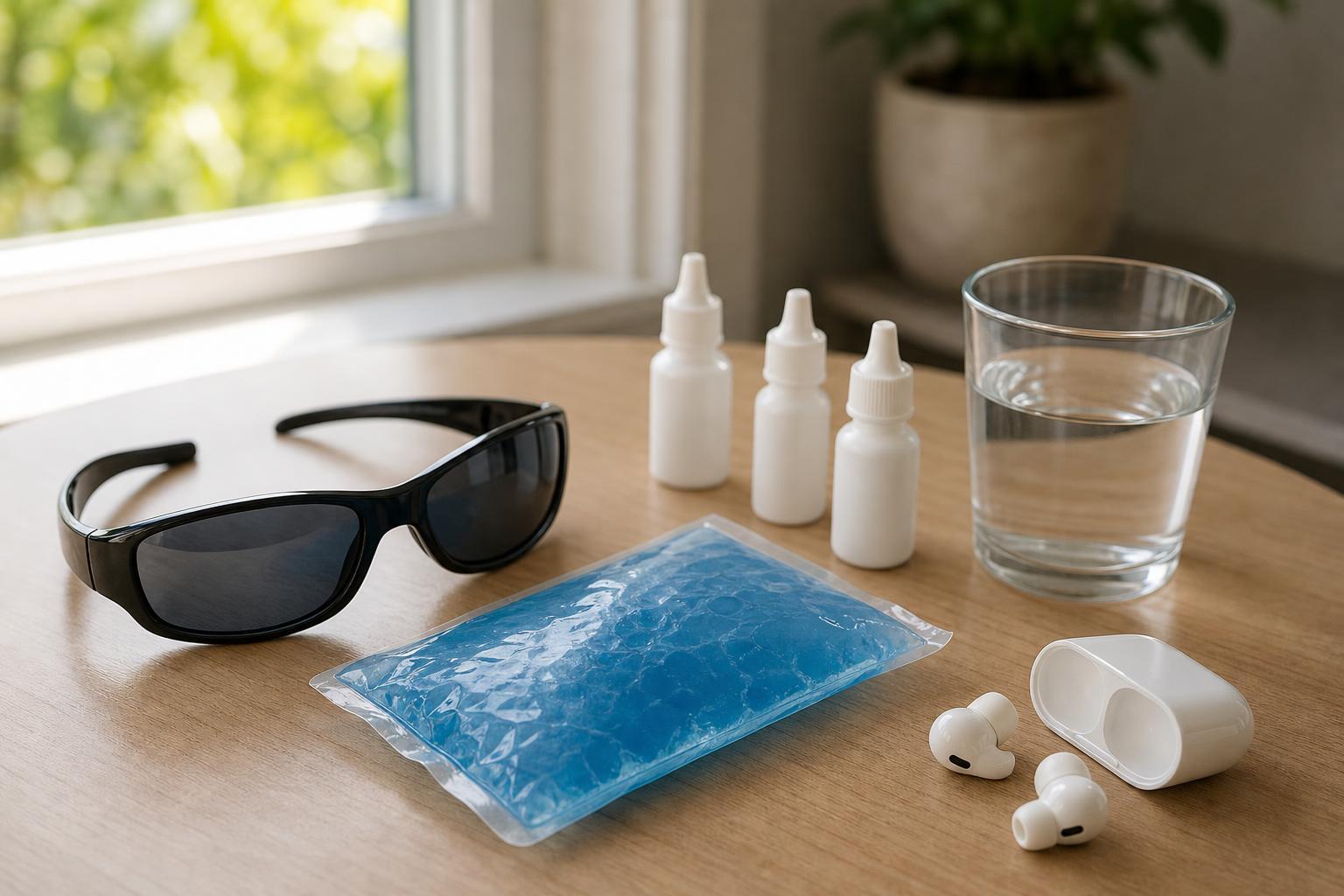
- Take your pain tablets before the pain starts. The eye often doesn’t start hurting until a few hours after surgery, so start the tablets once you get home.
- Use the numbing drops as needed for the first 3 days, then stop. They help with pain, but you must not keep using them after day 3.
- Ice packs placed gently over your closed eyes for the first 3 days often help a lot.
- Rest with your eyes closed. Many people listen to music, podcasts or audiobooks for the first few days.
- Nausea usually comes from the strong pain tablet. If it becomes a problem, stop that tablet; it can take about 6 hours for the nausea to settle.
Anti-inflammatory drops are part of the plan. A 2024 review of 27 trials found they lowered pain in the first days after PRK compared with placebo drops (Ben Ephraim Noyman et al., 2024).
The bandage contact lens
At the end of the procedure, we put a soft contact lens on each eye. It works like a bandage, smoothing over the healing surface and making the first days more comfortable.
- If it falls out, leave it out and throw it away. It is only helpful for the first few days.
- If it feels scratchy around day 4 or 5, the lens has usually dried out. Use your lubricating drops every 15 minutes for 3 to 4 hours, which often makes it comfortable again.
- If it is still uncomfortable, you can take it out yourself. Wash your hands first. In the first few days, though, the eye often feels sorer once the lens is out.
Eye drops
| Drop | How long |
|---|---|
| Antibiotic | 1 week (keep it until your 1-week check) |
| Anti-inflammatory (steroid) | 4 weeks, then stop |
| Anti-inflammatory (non-steroid) | The first 4 days, including the day of surgery |
| Lubricating (artificial tears) | Often for the first month, then as needed for 2 more months |
| Numbing drops | As needed for the first 3 days, then you must stop |
- Start your drops 2 hours after surgery, and do the full day’s doses before bed, even if your surgery was late in the day.
- Leave 5 minutes between different drops, and put the lubricating drops in last so they don’t wash the others out.
- Lost your drops? Your script has repeats.
Your drops are prepared by an external pharmacy and paid for separately; they aren’t included in the surgery price.
Your vision as you heal
- The first week. Vision is blurry, and it’s common for it to get worse on day 3 or 4 as the surface heals over, then improve from day 5. TransPRK has been reported to heal faster than conventional PRK (Alasbali, 2022), but the pattern is similar.
- Good and bad days are normal for the first 4 to 6 weeks, mostly because the newly healed surface is a little irregular and dry.
- One eye is often blurrier than the other, because each eye heals differently. Most of the difference has gone by 1 month, though it can take a second month. Try not to keep comparing your eyes.
- Close work and screens. Some people see well in the distance but find the computer or phone hard for a month or two while the focusing muscles adjust. A weak pair of reading glasses from the chemist (+1.00 to +1.50) can help in the meantime. Glare from screens is normal for the first month or two.
- Your old glasses generally won’t help while you heal.
Watch: what to expect 1 week after PRK
Sunglasses: 3 weeks, then 3 months
Wear sunglasses every time you go outside for the first 3 weeks, even just to check the mailbox or hang out the washing. After that, wear them most of the time you are outdoors for 3 months.
Use the pair in your post-op pack, or good-quality wraparound or thick-sided sunglasses (not aviators) that meet the Australian UV400 standard. UV protection while the surface heals is standard after PRK; with it, one study found that having PRK in summer made no difference to haze compared with winter (Özdemir et al., 2026).
Driving, work and flying
- Driving: usually after 5 to 7 days, at or after your 1-week check, once your vision is back to normal and meets the legal standard for driving (Austroads). It can take longer.
- Desk work: most people take 7 to 10 days off.
- Dusty, outdoor or manual work: about 2 weeks. See laser eye surgery for tradies.
- Flying: after 1 week.
- Alcohol: not for 24 hours, and never with your pain relief.
Exercise, swimming and everyday life
| Activity | When |
|---|---|
| Shower | After 1 day |
| Washing your hair, face make-up | After 2 days |
| Jogging, gym weights, pilates, yoga | After 2 days |
| Eye make-up | After 1 week |
| Cycling, tennis, golf | After 1 week |
| Horse riding, skiing, sailing | After 2 weeks |
| Hair colouring | After 2 weeks |
| Swimming and surfing | After 4 weeks |
| Contact sport (boxing, martial arts, rugby, soccer), squash | After 4 weeks |
| Scuba diving, sauna, steam room, hot yoga | After 4 weeks |
| Eyelash tint or extensions | After 4 weeks |
Rubbed your eye by accident? You don’t need to call, as long as your vision hasn’t changed.
Dry eye
Everyone gets some dry eye after laser eye surgery. Most people notice it as blurry vision that clears when they blink rather than a dry feeling, and some people get watery eyes. It usually lasts 4 to 12 weeks. The more you use your lubricating drops, the faster it settles and the better your vision at your 1-week check; some people use them hourly while awake.
Some people also take an omega-3 supplement, such as krill oil or an algae-based one if they are vegetarian. The evidence is mixed: in a large trial in people with dry eye disease, omega-3 capsules worked no better than placebo (DREAM Study Research Group, 2018).
Risks of PRK and TransPRK
Because there is no flap, PRK and TransPRK avoid flap complications, but they have their own risks (AAO EyeWiki):
- Haze, a faint scar that can blur vision, is the main specific risk. Mitomycin C, a medication applied briefly at the end of treatment, lowers the risk (Chang et al., 2021).
- Infection is rare but more likely than after LASIK, because the surface heals under a bandage lens: about 1 in 7,400 PRK procedures (Schallhorn et al., 2017).
- Under- or over-correction, dry eye, glare and halos, which are usually temporary or treatable.
This video explains the risks we discuss with you before PRK. For the full picture, with rates for each procedure, see laser eye surgery risks.
When to call us
Very blurred vision and sore eyes are expected for the first week or so after PRK. Call us if:
- your vision isn’t what you expected, or is getting worse rather than better
- you have severe pain that your pain relief isn’t controlling.
Call (07) 3239 5005 in business hours. After hours, contact your surgeon using the details in your aftercare brochure. If you can’t reach us, go to a hospital emergency department.
Your results
In a series of 205 eyes treated with StreamLight TransPRK in Brisbane, published by Dr David Gunn and Rebecca Cox, 95.6% of eyes saw 20/20 or better without glasses and 92.2% finished within 0.50 dioptres of the planned prescription (Gunn and Cox, 2024). Our TransPRK results page explains the study. Individual results vary.
If a small prescription remains, laser fine-tuning is free for two years under our enhancement policy.
Old glasses and contact lenses: bring them to your post-op appointment. We donate them to a charity that helps people who can’t afford glasses or contact lenses.
Planning your PRK or TransPRK
TransPRK at Focus Vision is $3,500 per eye (see costs). Both eyes are usually treated on the same day. You’re awake, with numbing drops and relaxing medication. For how PRK recovery compares with LASIK and CLEAR, see our laser eye surgery recovery timeline and types of laser eye surgery.
Start with a free optometrist assessment to explore your suitability. Every patient proceeding to surgery then has a paid consultation with a specialist surgeon to confirm suitability, discuss their procedure and plan surgery. The consultation fee is deducted from the surgery price for every procedure. See consultation and pricing details.
References
- Ben Ephraim Noyman D, Sommer AC, Naaman E, et al. Topical nonsteroidal anti-inflammatory drugs for management of pain after PRK: systematic review and network meta-analysis. J Cataract Refract Surg. 2024;50(10):1083-1091. pubmed.ncbi.nlm.nih.gov/39025658
- Alasbali T. Transepithelial photorefractive keratectomy compared to conventional photorefractive keratectomy: a meta-analysis. J Ophthalmol. 2022;2022:3022672. pubmed.ncbi.nlm.nih.gov/36051276
- Özdemir HE, Albayrak MT, Koçluk Y, et al. Seasonal effects on corneal densitometry and haze after mitomycin C-assisted photorefractive keratectomy. J Clin Med. 2026;15(12). pubmed.ncbi.nlm.nih.gov/42355751
- Austroads. Assessing Fitness to Drive: vision and eye disorders, general assessment and management guidelines. austroads.gov.au
- Dry Eye Assessment and Management Study Research Group; Asbell PA, et al. n-3 fatty acid supplementation for the treatment of dry eye disease. N Engl J Med. 2018;378(18):1681-1690. pubmed.ncbi.nlm.nih.gov/29652551
- American Academy of Ophthalmology. Photorefractive Keratectomy. EyeWiki. eyewiki.aao.org/Photorefractive_Keratectomy
- Chang YM, Liang CM, Weng TH, Chien KH, Lee CH. Mitomycin C for the prevention of corneal haze in photorefractive keratectomy: a meta-analysis and trial sequential analysis. Acta Ophthalmol. 2021;99(6):652-662. pubmed.ncbi.nlm.nih.gov/33326173
- Schallhorn JM, Schallhorn SC, Hettinger K, Hannan S. Infectious keratitis after laser vision correction: incidence and risk factors. J Cataract Refract Surg. 2017;43(4):473-479. pubmed.ncbi.nlm.nih.gov/28532931
- Gunn DJ, Cox RA. StreamLight single-step transepithelial photorefractive keratectomy (PRK) for myopia and myopic astigmatism. J Ophthalmol. 2024;2024:5597457. pubmed.ncbi.nlm.nih.gov/39575318