
Short answer: Recovery from ICL surgery is quick for most people. You’re essentially asleep for the operation, and most people see much better within 24 hours. You wear a clear shield for 2 hours after surgery and to bed for 3 nights. An optometrist checks your eyes the day after surgery. You use antibiotic drops for 1 week and anti-inflammatory drops for 3 weeks. Most people drive again after 1 to 2 days and take 2 to 4 days off work, return to exercise after 72 hours, and wait 4 weeks before swimming or contact sport.
Watch: your recovery from ICL surgery
You’ll watch this video in the recovery area of the hospital after your ICL surgery. It explains what to expect and how to look after your eyes in the first weeks.
ICL recovery timeline
| When | What to expect |
|---|---|
| The day of surgery | You’re essentially asleep, with heavy sedation from a specialist anaesthetist. Someone takes you home. Keep the shield on for 2 hours, then take it off and start your drops. Vision is blurry at first. |
| The first night | Wear the shield to bed. A scratchy, watery eye and mild discomfort are normal; paracetamol helps. |
| The next day | Your check-up with our optometrist. Vision ranges from very good to quite blurry, and one eye may be clearer than the other. Don’t drive yourself to the check-up. |
| The first 3 nights | Wear the shield to bed. |
| 1 to 2 days | Most people can drive again. |
| 2 to 4 days | Most people are back at a desk job. |
| 72 hours | Back to exercise and normal activity, as long as the eye stays clean. |
| 1 week | Antibiotic drops finish. Eye makeup is fine again, and you no longer need to keep your eyes closed in the shower. Back to dusty, outdoor or manual work. |
| 3 weeks | Anti-inflammatory drops finish. |
| 4 weeks | Back to swimming and contact sport. The no-rubbing period ends. |
| Up to 3 months | Lubricating drops as needed if the eye feels dry or scratchy. |
The day of surgery and the first night
At Focus Vision, ICL surgery is done in an accredited day hospital under heavy sedation from a specialist anaesthetist, so you’re essentially asleep and most people remember little or nothing. Every lens we implant is the STAAR Surgical EVO ICL. Your drops are prepared by an external pharmacy and given to you on the day.
- Someone needs to take you home after sedation.
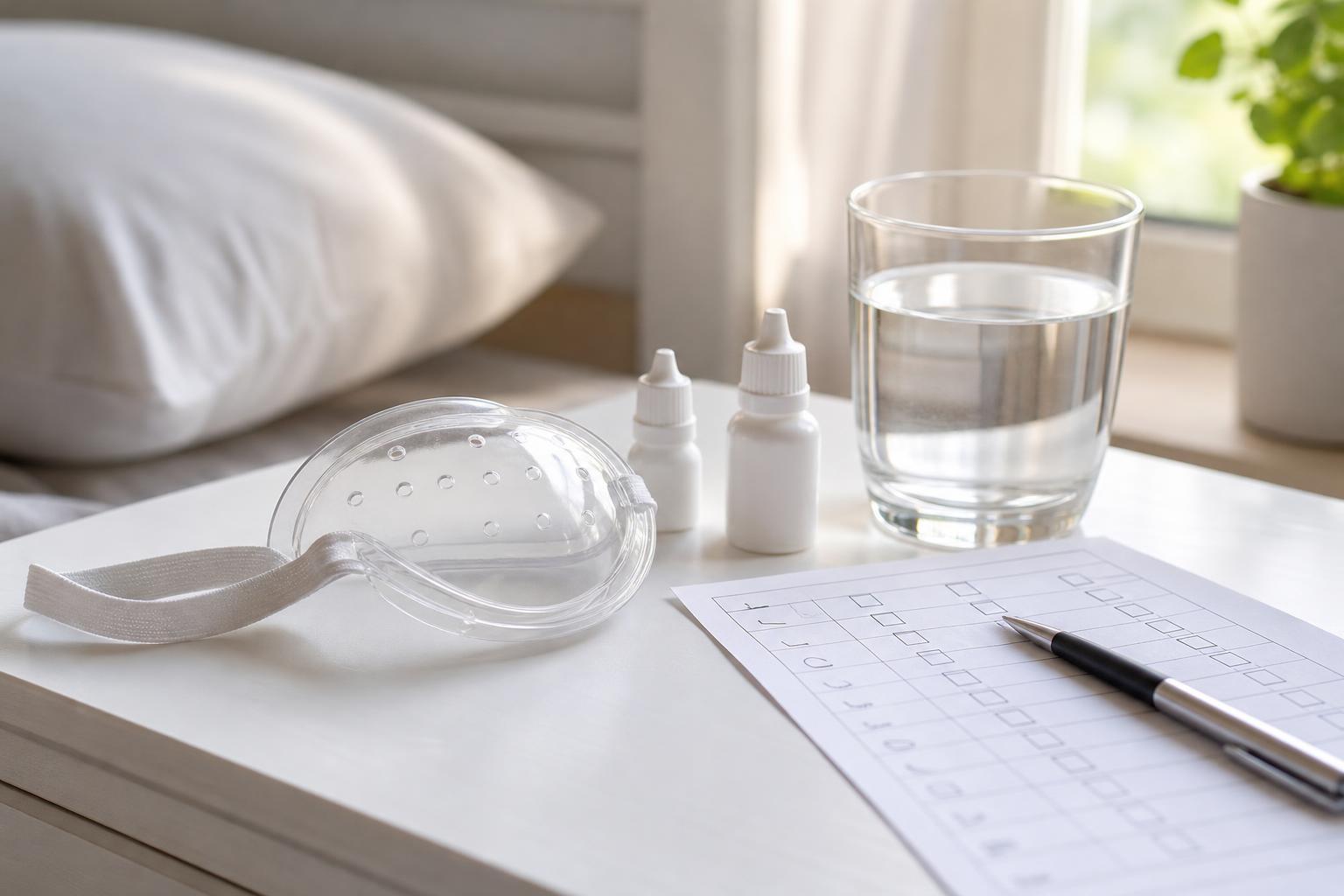
- Keep the clear plastic shield on for 2 hours. Then take it off and start your drops. Some people find it more comfortable to keep the shield on, but you don’t need to, as long as you don’t rub your eyes.
- Blurry vision is normal on the day.
- Eat, drink and rest as usual. Most people feel tired after the day and have an early night.
- Mild discomfort is common as the anaesthetic wears off. Paracetamol is enough for most people. A scratchy, irritated or watery eye is normal.
- Bruising and blood-stained tears. A bruised eyelid from the anaesthetic is common, and some people have blood-stained tears the night after surgery, more so if you take blood thinners.
- Wear the shield to bed for the first 3 nights, so you don’t rub your eyes in your sleep.
- No alcohol for 24 hours, and never mix alcohol with the relaxing medication or pain relief.
The next morning and your check-up
Don’t worry if your eyelids are a little stuck together when you wake up. Clean them gently with a fresh tissue moistened with cooled boiled water, or with your lubricating drops.
Your vision the next morning can range from very good to quite blurry, and one eye is often clearer than the other. Both are normal. Most people see much better within 24 hours.
You see one of our optometrists at Focus Vision the day after surgery. They check your vision, your eye pressure and the position of the lens. Eye pressure can rise in the first hours after ICL surgery, partly from the gel used to protect the eye during the operation (Zhang et al., 2021), which is why the early check matters. Don’t drive yourself to this appointment, even if you feel you can.
The EVO ICL has a tiny central port that lets fluid flow through the lens naturally. Because of it, you don’t need a laser hole in the iris before surgery, and the lens has lower rates of pupillary block and cataract than earlier ICL designs (Packer, 2018). In the 3-year US trial of 629 eyes, no eye developed pupillary block or raised pressure from angle narrowing (Parkhurst et al., 2025).
Watch: what to expect 1 week after ICL surgery
Eye drops: 1 to 3 weeks
| Drop | How often | How long |
|---|---|---|
| Antibiotic | 4 times a day | 7 days, then stop |
| Anti-inflammatory (steroid) | 4 times a day | 21 days |
| Lubricating (artificial tears) | Whenever the eye feels dry or scratchy | As needed, for up to 3 months |
- Leave 5 minutes between different drops, so one doesn’t wash out the other.
- Wash your hands before putting drops in.
- Tick off each dose on the chart in your aftercare brochure.
- Lost your drops? Missing a few won’t hurt. Your script has repeats, and we can arrange a new one the next working day.
The antibiotic protects against infection, and the steroid settles inflammation. Infection after ICL surgery is very rare: an international survey of almost 18,000 ICL operations found about 1 case in 6,000 (Allan et al., 2009). Prescribed drops are paid for separately and aren’t included in the surgery price.
Going back to work
Most people take 2 to 4 days off a desk job. If you work in a dusty, outdoor or manual environment, plan on about a week off.
When can you drive after ICL surgery?
Most people can drive 1 to 2 days after ICL surgery. Don’t drive on the day of surgery, and don’t drive yourself to your check-up the next morning, even if you feel you can. You can drive once:
- your vision is back to normal
- your eyes are comfortable
- your vision meets the legal standard for driving (Austroads)
Exercise, swimming and everyday life
| Activity | When |
|---|---|
| Walking and rest | Straight away |
| Exercise and normal activity | After 72 hours, as long as the eye stays clean |
| Showering and washing your hair | Straight away, but keep your eyes closed under the water for 1 week and keep soap and hair products out of your eyes |
| Eye makeup | After 1 week |
| Contact sport | After 4 weeks |
| Swimming (pool, ocean or spa) | After 4 weeks, because of the risk of infection |
| Rubbing your eyes | Avoid for 4 weeks |
- Sunglasses aren’t essential, but bright lights can feel startling for a few weeks.
- Rubbed your eye by accident? Don’t worry, unless it causes severe pain or your vision drops.
- Alcohol, smoking and vaping aren’t good for your eyes. Smoking and vaping carry a risk of blindness. If you drink, stay within the Australian guidelines: no more than 10 standard drinks a week and no more than 4 on any one day (NHMRC).
Dry, scratchy or red eyes
A red eye, a mild itch or a gritty feeling are common for a few weeks after ICL surgery. The gritty feeling comes from the eye being dry. Many people don’t notice any dryness, but if you do, use your lubricating drops as needed. It settles over 8 to 10 weeks.
In a study of 117 eyes, dry-eye symptoms were higher 1 month after ICL surgery and had partly recovered by 3 months. People who already had dry eye before surgery noticed it more (Chen et al., 2021). If you’ve had dry eye before, tell us at your assessment.
When to call us
Emergencies after ICL surgery are extremely rare, but some symptoms need a call straight away:
- A significant headache in the first 24 hours. Call your surgeon, because this can be a sign of raised eye pressure.
- Significant pain or reduced vision in the first 2 weeks.
Call (07) 3239 5005 in business hours. After hours, contact your surgeon on the numbers in your aftercare brochure. If you can’t reach us, go to a hospital emergency department.
Your results and long-term care
Most people’s vision is excellent once the eye has settled. In the 3-year US trial, 90.7% of eyes were within 0.50 D of the planned prescription (Parkhurst et al., 2025). If a small prescription remains, laser fine-tuning is free for two years under our enhancement policy. Regular reviews keep an eye on the lens over the long term; read more in How long do ICLs last? and Are implantable contact lenses safe?
Old glasses and contact lenses: bring them to your post-op appointment. We donate them to a charity that helps people who can’t afford glasses or contact lenses.
Planning your ICL surgery
ICL surgery at Focus Vision is from $7,000 per eye, including the anaesthetist (see costs). Both eyes can be done on the same day or on separate days. Read ICL cost in Australia, or compare options in ICL vs laser eye surgery for high prescriptions.
Start with a free optometrist assessment to explore your suitability. Every patient proceeding to surgery then has a paid consultation with a specialist surgeon to confirm suitability, discuss their procedure and plan surgery. The consultation fee is deducted from the surgery price for every procedure. See consultation and pricing details.
References
- Zhang Z, Niu L, Zhao J, et al. Safety of EVO ICL implantation with an ophthalmic viscosurgical device-free technique in the early 24 h after surgery. Front Med (Lausanne). 2021;8:764653. pubmed.ncbi.nlm.nih.gov/34869472
- Packer M. The Implantable Collamer Lens with a central port: review of the literature. Clin Ophthalmol. 2018;12:2427-2438. pubmed.ncbi.nlm.nih.gov/30568421
- Parkhurst G, Brinton JP, Faulkner A, et al. Three year results from the United States FDA prospective multicenter clinical study of the EVO/EVO+ Implantable Collamer Lens. Clin Ophthalmol. 2025;19:3237-3248. pubmed.ncbi.nlm.nih.gov/40937096
- Allan BD, Argeles-Sabate I, Mamalis N. Endophthalmitis rates after implantation of the intraocular Collamer lens: survey of users between 1998 and 2006. J Cataract Refract Surg. 2009;35(4):766-769. pubmed.ncbi.nlm.nih.gov/19304102
- Chen H, Feng X, Niu G, et al. Evaluation of dry eye after Implantable Collamer Lens surgery. Ophthalmic Res. 2021;64(3):356-362. pubmed.ncbi.nlm.nih.gov/32966980
- Austroads. Assessing Fitness to Drive: vision and eye disorders, general assessment and management guidelines. austroads.gov.au
- National Health and Medical Research Council. Australian guidelines to reduce health risks from drinking alcohol. nhmrc.gov.au/health-advice/alcohol