
Short answer: If you’ve had cataract surgery (or lens replacement) with a standard monofocal lens and now wish you didn’t need reading glasses, you may not need to have that lens taken out. A multifocal upgrade lens, the 1stQ AddOn Trifocal, can be placed in front of your existing lens to add near and intermediate vision (1stQ). In published studies, most patients no longer needed glasses for most tasks (Palomino-Bautista et al., 2020; Albayrak et al., 2021). The studies are small and short-term, and the lens isn’t right for every eye, so your surgeon will check your eyes first. If you haven’t had surgery yet, the same lens can also be placed at your first operation, in front of a monofocal lens, so the multifocal part can be removed later if needed (an approach 1stQ calls Liberty2, which we offer at Focus Vision).
Who this is for
Most people who have cataract surgery receive a monofocal lens, which focuses clearly at one distance, usually far. You see well for driving and television but need glasses for reading. That is a sensible choice for many people, but you might later want more:
- You’ve changed your mind. You chose a monofocal lens, perhaps to keep costs down or because halos at night worried you, and now find reading glasses a nuisance.
- A multifocal lens wasn’t discussed or available at the time. Not every patient is offered one at their original surgery, for many reasons.
- Your first eye taught you what you want. Some people only realise how much they want to be free of reading glasses once their distance vision is clear.
Until recently, the main surgical option was to remove the original lens and replace it with a multifocal one (a lens exchange). That is a bigger operation. In a study comparing ways of correcting a leftover prescription after cataract surgery, 85% of eyes with a second (piggyback) lens were within 1.00 D of target, compared with 62.5% after lens exchange (Fernández-Buenaga et al., 2013). An upgrade lens, which leaves your original lens in place, is often a simpler alternative.
How the multifocal upgrade lens works
The 1stQ AddOn is a supplementary lens: a second lens that works together with the one you already have. It is TGA-approved and available in Australia.
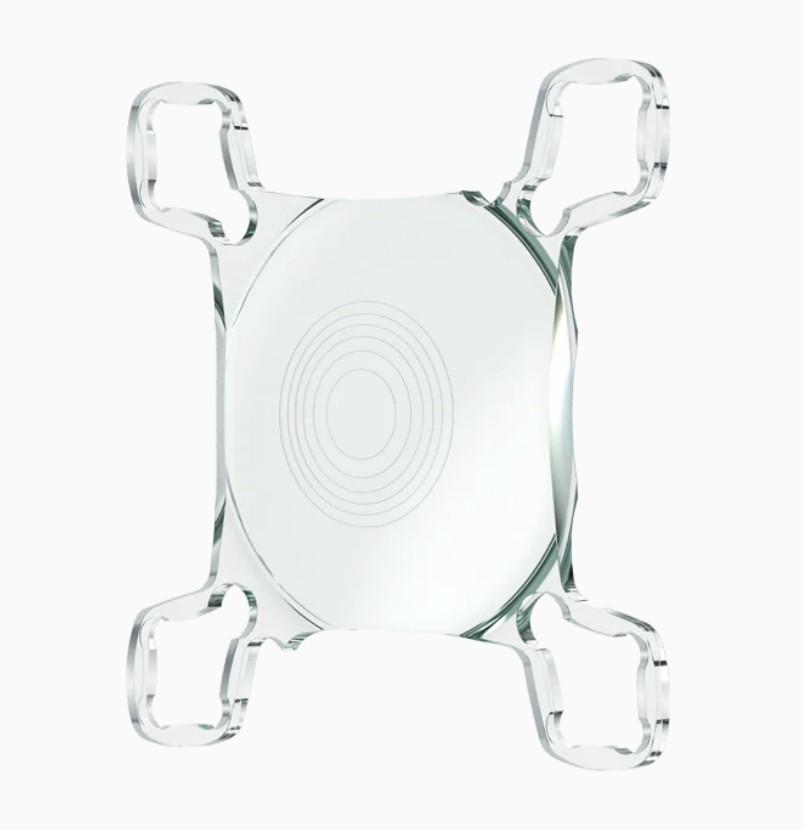
- Where it sits. Your existing lens sits inside the capsular bag, the thin membrane that held your natural lens. The AddOn sits just in front of it, in a groove called the ciliary sulcus, behind the iris (1stQ).
- Its shape. The lens is made of soft hydrophilic acrylic, and its back surface is concave, so it arches over your existing lens rather than touching it (1stQ).
- What it adds. The trifocal version adds focus for near and intermediate distances, such as reading and computer work. A toric version also corrects astigmatism, and a monofocal version can correct a leftover distance prescription (1stQ; Gundersen & Potvin, 2017).
- It is designed to be reversible. Because your original lens isn’t disturbed, the add-on lens can be removed if needed, for example if you can’t adapt to multifocal vision (Khoramnia et al., 2025; EyeWiki).
Why this is different from older “piggyback” lenses. Placing two lenses together isn’t new, but earlier methods, with both lenses in the capsular bag, or a lens designed for the bag placed in the sulcus, had unacceptable complication rates and are now largely abandoned. Modern supplementary lenses such as the AddOn are designed specifically for the sulcus, to sit clear of the original lens and the iris (Khoramnia et al., 2025; EyeWiki).
What the evidence shows
| Study | Eyes | Follow-up | Key results |
|---|---|---|---|
| AddOn Trifocal (Palomino-Bautista et al., 2020) | 18 | 6 months | 83% within 0.5 D of target; all patients free of glasses at all distances; no adverse change in eye pressure or corneal cells |
| AddOn Trifocal (Albayrak et al., 2021) | 28 | 6 months | Near vision without glasses improved markedly; 89% within 1.0 D of target; contrast sensitivity unchanged; no complications |
| AddOn monofocal and toric, for leftover prescription (Gundersen & Potvin, 2017) | 46 | — | Vision without glasses improved by about two lines; no eye lost best-corrected vision |
How to read this. These results are encouraging, but the studies are small and short-term. Larger and longer-term studies are still needed, and a review of supplementary lenses notes that results depend strongly on lens design (Khoramnia et al., 2025). Your surgeon will talk you through what is known and what isn’t.
Planning ahead: Liberty2, two lenses at the first operation
If you are having cataract surgery or refractive lens exchange now and would like multifocal vision, but want a way back if it doesn’t suit you, there is another approach, which Focus Vision offers. 1stQ calls it Liberty2 (1stQ):
- a monofocal (or toric) lens is placed in the capsular bag, as in standard cataract surgery; and
- a trifocal AddOn is placed in front of it, in the sulcus, in the same operation.
The monofocal lens does the main focusing work, and the AddOn adds near and intermediate vision. Because the multifocal part sits separately in front, it is designed to be removed or exchanged later if needed, leaving you with a standard monofocal lens (1stQ; Khoramnia et al., 2025). Surgeons call this a “duet” procedure, or reversible multifocality.
Why you might choose it. A standard multifocal lens sits in the capsular bag, and removing it later is a bigger operation. With Liberty2, the multifocal part can come out if:
- you find halos or glare at night hard to live with;
- you later develop an eye condition, such as macular degeneration, that makes a multifocal lens less suitable (Brunner et al., 2025); or
- a different lens would suit you better in future.
The authors of one study described the duet approach as offering “an exit strategy” for future loss of function or side effects of the optics (Baur et al., 2022).
What the evidence shows.
- In a study of 25 patients who had a duet procedure, vision without glasses was about 6/6 (20/20) on average at distance, with good intermediate and near vision, results the authors judged comparable to a trifocal lens in the capsular bag (Baur et al., 2022).
- A comparison of 32 duet eyes with 57 eyes that had a single multifocal lens found no significant difference in distance or near vision without glasses at one year. Brief pressure rises on the first day occurred in both groups and had settled by one year (Harrisberg et al., 2023).
- In 80 eyes with mild co-existing eye conditions, a duet procedure gave clearly better distance and near vision without glasses at three months (Brunner et al., 2025).
- In laboratory testing of the Liberty2 combination itself, its optical quality was comparable to a single trifocal lens in the capsular bag (Khoramnia et al., 2023).
The caveats. Most published duet studies used another manufacturer’s sulcus lens, and clinical results for Liberty2 specifically are still limited. Being removable is the design purpose; no study has yet compared the safety of removing a sulcus lens with exchanging a capsular-bag lens. Two lenses also means a slightly longer procedure, and the risks of a sulcus lens described below apply. Your surgeon will discuss whether Liberty2, a single multifocal lens, or a monofocal lens suits your eyes.
Who is suitable?
A multifocal upgrade lens may suit you if:
- you have a monofocal lens implant from cataract surgery or lens replacement, and your eye has settled;
- you want to rely less on reading glasses;
- your eyes are otherwise healthy, including your retina and macula;
- you understand that, like other multifocal lenses, it can cause halos and glare around lights at night.
It may not suit you if you have (EyeWiki):
- a shallow front chamber of the eye or a narrow drainage angle;
- pigment dispersion syndrome or uncontrolled glaucoma;
- a low count of corneal endothelial cells (the cells that keep the cornea clear);
- active inflammation in the eye (uveitis).
Significant macular disease or other conditions that reduce the quality of your vision also make multifocal lenses less suitable. Your surgeon will measure the front of your eye, check your corneal cells and pressure, and examine your retina before recommending it.
The procedure
The lens is inserted through a small incision of about 2 mm, without removing the lens you already have (1stQ). It is a short day procedure, performed in an accredited day hospital. Recovery is usually quick, with follow-up visits to check your vision, eye pressure and the lens position.
Risks. As with any lens surgery, they include infection and inflammation, raised eye pressure, and the lens sitting off-centre or needing repositioning. Problems seen with older piggyback methods, such as clouding between the two lenses and pigment rubbing off the iris, are what the sulcus design aims to avoid (EyeWiki). Halos, glare and some loss of contrast are possible with any multifocal optic. If you can’t adapt, the lens can be removed.
Other options
A multifocal upgrade lens is one of several ways to reduce your need for glasses after cataract surgery:
| Option | What it involves | Things to know |
|---|---|---|
| Reading glasses | No surgery | Simple and reliable |
| Multifocal upgrade lens | A second lens added in front of your existing lens | Adds near and intermediate vision; designed to be reversible |
| Laser on the cornea | LASIK or surface laser, for example to set up blended vision | Very accurate for correcting a leftover prescription (Fernández-Buenaga et al., 2013); needs a healthy cornea |
| Lens exchange | Removing your lens and replacing it with a multifocal one | A bigger operation; less predictable than a second lens in one comparison (Fernández-Buenaga et al., 2013) |
Which suits you depends on your eyes, how you use them and what you want to see without glasses. See how to get rid of reading glasses and our guide to lens types.
Cost and Medicare
Medicare doesn’t cover a multifocal upgrade lens. The Medicare items for inserting or replacing an intraocular lens exclude surgery done to correct a refractive error, with a narrow exception for a large difference between the two eyes after cataract surgery on the first eye (MBS item 42701; MBS item 42707). Adding a lens to reduce your need for reading glasses counts as refractive surgery, so health funds generally don’t pay towards it either.
Your cost depends on your eyes and the lens needed, and is confirmed in a written quote after your assessment. See our costs page for our other procedures.
Had your cataract surgery somewhere else?
That’s fine. Bring any information you have about your lens implant, such as the lens card or your operation report.
To find out whether a multifocal upgrade lens could suit your eyes, book an assessment or call (07) 3239 5005.
References
- 1stQ GmbH. AddOn sulcus IOL for pseudophakic eyes (product information). 1stq.de/en/addon-iol
- 1stQ GmbH. AddOn multifocal intraocular lenses (product information). 1stq.de/en/intraocular-lenses/multifocal
- Palomino-Bautista C, Sánchez-Jean R, Carmona Gonzalez D, et al. Spectacle independence for pseudophakic patients – experience with a trifocal supplementary add-on intraocular lens. Clin Ophthalmol. 2020;14:1043-1054. doi:10.2147/OPTH.S238553. pmc.ncbi.nlm.nih.gov/articles/PMC7156274
- Albayrak S, Comba ÖB, Karakaya M. Visual performance and patient satisfaction following the implantation of a novel trifocal supplementary intraocular lens. Eur J Ophthalmol. 2021. doi:10.1177/1120672120969042. pubmed.ncbi.nlm.nih.gov/33158370
- Gundersen KG, Potvin R. A review of results after implantation of a secondary intraocular lens to correct residual refractive error after cataract surgery. Clin Ophthalmol. 2017;11:1791-1796. pubmed.ncbi.nlm.nih.gov/29042749
- Khoramnia R, Kahraman G, Amon M, et al. Polypseudophakia: from “piggyback” to supplementary sulcus-fixated IOLs. Graefes Arch Clin Exp Ophthalmol. 2025;263(3):603-624. doi:10.1007/s00417-024-06618-3. pmc.ncbi.nlm.nih.gov/articles/PMC11953199
- American Academy of Ophthalmology. Special cases: secondary piggy-back lenses. EyeWiki. eyewiki.org/Special_Cases:_Secondary_Piggy-Back_Lenses
- Fernández-Buenaga R, Alió JL, et al. Resolving refractive error after cataract surgery: IOL exchange, piggyback lens, or LASIK. J Refract Surg. 2013;29(10):676-683. pubmed.ncbi.nlm.nih.gov/23991761
- Australian Government. MBS item 42701: intraocular lens, insertion of. privatehealth.gov.au. privatehealth.gov.au/dynamic/MBSItems/Cataracts/42701
- Australian Government. MBS item 42707: intraocular lens, removal and replacement. privatehealth.gov.au. privatehealth.gov.au/dynamic/MBSItems/Cataracts/42707
- 1stQ GmbH. Liberty2: reversible presbyopia correction (product information). 1stq.de/en/intraocular-lenses/liberty2
- Baur ID, Auffarth GU, Łabuz G, et al. Clinical outcomes in patients after duet procedure for reversible trifocality using a supplementary trifocal intraocular lens. Am J Ophthalmol. 2022;241:217-226. doi:10.1016/j.ajo.2022.04.021. pubmed.ncbi.nlm.nih.gov/35526588
- Harrisberg BP, Chua AW, Chua MJ, et al. Comparison of primary duet lens procedures: in-the-bag monofocal with sulcus multifocal, and standard single multifocal lens for cataract surgery. Clin Ophthalmol. 2023;17:273-282. pubmed.ncbi.nlm.nih.gov/36698853
- Brunner BS, Dirisamer M, Luft N, et al. Feasibility and postoperative outcome after duet procedure for reversible multifocality in eyes with co-pathologies. J Clin Med. 2025;14(15):5583. pubmed.ncbi.nlm.nih.gov/40807200
- Khoramnia R, Baur ID, Yan W, et al. Comparison of a presbyopia-correcting supplementary intraocular lens combination and a capsular-bag lens: an in vitro study. Diagnostics. 2023;13(8):1482. pubmed.ncbi.nlm.nih.gov/37189583