
If you are over 40 and have started holding the menu at arm’s length, you have presbyopia, the age-related stiffening of the eye’s natural lens that affects an estimated 1.8 billion people worldwide (Fricke et al., 2018). Reading glasses fix it, and most people would rather not need them.
The question we are asked most is whether laser eye surgery can get rid of reading glasses. The answer is yes, for many people, and there are lens-based and inlay options for those it does not suit. This guide explains what presbyopia is, every treatment Focus Vision offers for it, what the published results show, and how we decide which one is right for your eyes.
Why you need reading glasses after 40
Inside the eye, the natural lens changes shape to focus on near objects. In youth it is soft and flexible; after about 40 it becomes progressively stiffer and cannot change shape as easily, which makes reading, threading a needle and using a phone harder (AAO). Presbyopia is a normal part of ageing that affects nearly everyone, and it keeps progressing into the 60s. Distance vision usually stays clear at first, which is why so many people who never wore glasses suddenly need them for near.
The tell-tale signs are blurred near vision, holding reading material further away, needing brighter light to read, and eye strain or headaches after close work.
Non-surgical options
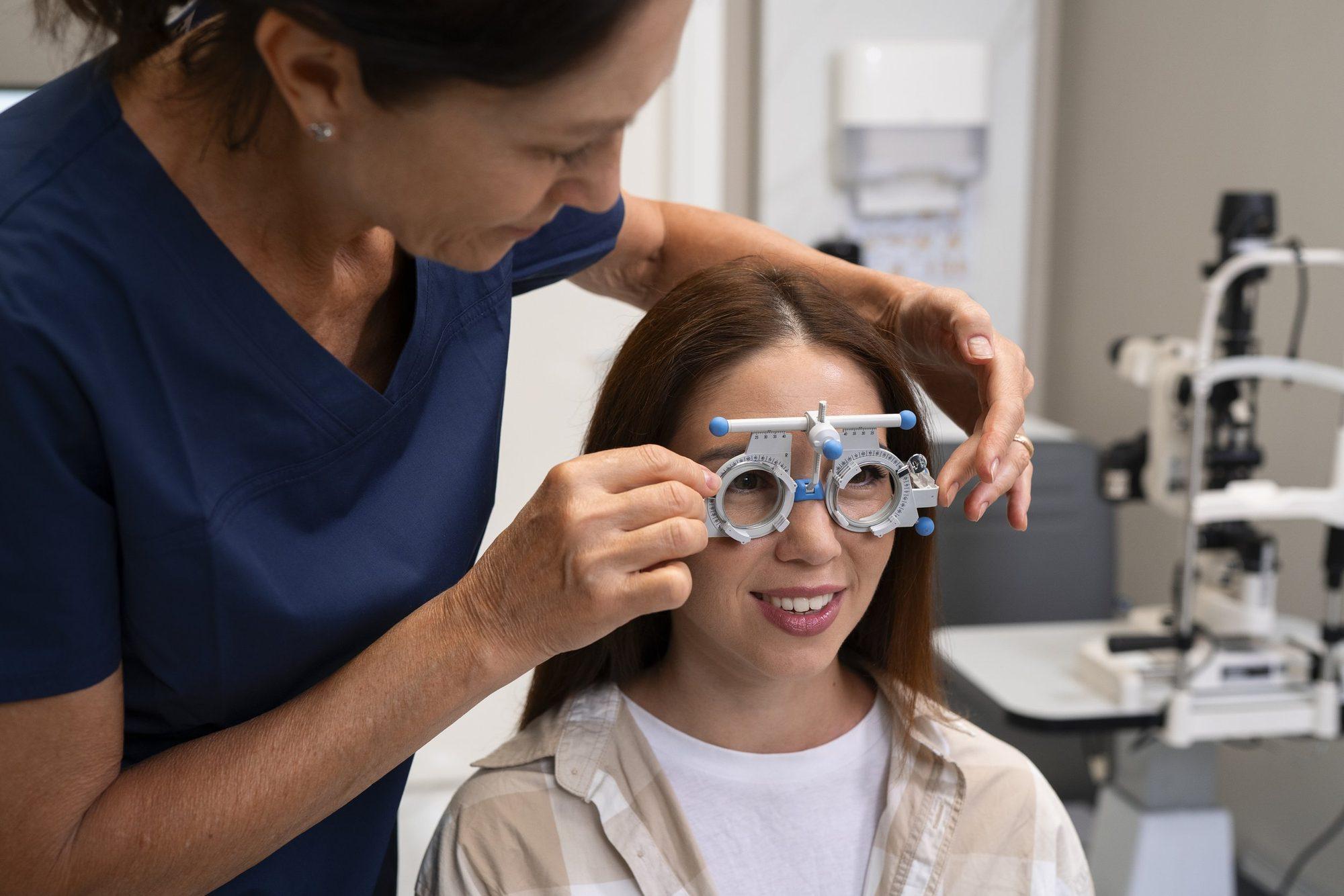
Reading glasses, multifocal spectacles and multifocal or monovision contact lenses all work, and for mild presbyopia they are the sensible first step. Monovision contact lenses, which correct one eye for distance and the other for near, succeed in roughly 59% to 67% of adapted contact lens wearers; stereopsis (depth perception) is reduced, although most wearers do not notice it (AAO EyeWiki). A contact lens trial of monovision is also the best way to find out whether you would adapt to Laser Blended Vision before committing to surgery, and we can arrange one.
Surgical options at Focus Vision
Laser Blended Vision
Laser Blended Vision is LASIK adapted for presbyopia. One eye is set fully for distance and the other slightly towards near, with the difference between them kept small (micro-monovision), and the laser profile extends the depth of focus of each eye so that the two ranges overlap. The brain blends the images into one continuous range of vision from far to near. It was developed by Reinstein and colleagues, who combined spherical aberration to extend each eye’s depth of field with a small anisometropia to cover near, intermediate and distance continuously (Russo et al., 2022).
The difference from old-fashioned monovision matters. Because the gap between the eyes is small, depth perception is largely preserved: in the published PRESBYOND series, stereoacuity was better than 100 seconds of arc in 79% of myopic and 85% of hyperopic patients (Russo et al., 2022). Most people find the blended focus feels natural within weeks, and the contact lens trial beforehand tells you in advance.
Laser Blended Vision suits people typically over 45 who have presbyopia, a stable prescription for at least a year, healthy eyes and a clear natural lens. If there is any cataract, lens surgery is the better route. Where a patient does not adapt to blended vision, an extended-depth-of-focus laser profile on the Alcon WaveLight platform is an alternative that extends the range of each eye without setting the eyes apart; your surgeon will discuss whether it suits you.

The Allotex corneal inlay
For people who see well in the distance and only need reading glasses, the Allotex allogenic corneal inlay adds near focus to the non-dominant eye without a laser prescription change. It is a wafer-thin disc of sterilised donor corneal tissue, about 2.6 mm across, placed under a thin flap and centred over the pupil. Earlier synthetic inlays were withdrawn from the market because of corneal haze and night-vision problems (AAO); the Allotex inlay is human tissue, which the cornea tolerates.
In the four-year European multicentre trial of 101 patients, uncorrected near vision of 20/40 or better (enough for newsprint) was achieved binocularly by 98.9% at six months and 98.6% at four years, distance vision was maintained, and three inlays were removed, all without lasting harm (European multicentre trial, J Refract Surg). A separate three-year study found the inlay more than doubled the eye’s depth of focus, from 1.1 D to 2.8 D, with a one-line loss of best-corrected distance vision in the treated eye in 24% of patients as its main limitation (Keskin Perk et al., 2023). The inlay is removable, so it is the most reversible of the surgical options.
Lens replacement with a multifocal or extended-depth-of-focus lens
From the 50s onwards, or as soon as the natural lens shows early cataract changes, refractive lens exchange becomes the treatment of choice. The natural lens is replaced with an artificial lens that provides more than one focal distance: a multifocal or trifocal lens, an extended-depth-of-focus lens that excels at intermediate and distance with useful near vision, or the Rayner Galaxy spiral lens, which in early results has given a range of vision comparable to a trifocal with better contrast sensitivity and fewer halos than diffractive trifocal lenses (J Refract Surg, 2025).
The operation is the same as cataract surgery, which the American Academy of Ophthalmology describes as generally safe and effective (AAO), and because the natural lens has been replaced, a cataract can never develop later. If a cataract is already present, cataract surgery with the same premium lenses achieves the same result.
How we choose between them
- In your 40s with a clear lens and a distance prescription too: Laser Blended Vision corrects both at once.
- In your 40s or 50s with good distance vision and only reading glasses: the Allotex inlay in one eye, or Laser Blended Vision.
- From the mid-50s, or with any early lens change: lens replacement with a multifocal or extended-depth-of-focus lens, for a result that will not drift as the lens ages.
- With a cataract: cataract surgery with a premium lens.
Whichever you choose, the honest limits are these. Blended vision and inlays work with your natural lens, which keeps stiffening, so reading vision can drift over the years and some people later move to lens surgery. Multifocal lenses trade a little contrast and some halos at night for spectacle independence, which is why lens choice is discussed carefully at your assessment.

What it costs in Brisbane
Laser Blended Vision is a LASIK procedure and is priced on our costs page alongside the other laser options; refractive lens exchange is from $6,000 per eye including the anaesthetist, with all pre-operative assessments, the procedure and a year of follow-up included and prescribed medications and eye drops extra. Interest-free plans over 24 months are available. Medicare does not cover surgery performed purely to reduce dependence on reading glasses; cataract surgery, when a cataract is present, is Medicare-eligible. The paid specialist surgeon consultation fee is deducted from the surgery price for every procedure if you proceed. Prescribed medications are purchased separately so eligible patients can use PBS subsidies for eligible prescriptions; see our pricing details.
Outcomes we measure, not just promise
Freedom from reading glasses depends on hitting the refractive target, so we measure how often we do. Dr Brendan Cronin and Dr David Gunn audit their refractive outcomes with the free Refractive Outcomes Analyzer they built and shared with the global ophthalmology community, benchmarking every result against published international standards.
Get in touch
If you would like to know which option would work for your eyes, book a free optometrist assessment. Call us on (07) 3239 5005, email hello@focusvision.com.au or contact us online.
References
- Fricke TR, Tahhan N, Resnikoff S, et al. Global Prevalence of Presbyopia and Vision Impairment from Uncorrected Presbyopia: Systematic Review, Meta-analysis, and Modelling. Ophthalmology. 2018;125(10):1492-1499. aaojournal.org
- American Academy of Ophthalmology. What Is Presbyopia? EyeSmart. aao.org/eye-health/diseases/what-is-presbyopia
- American Academy of Ophthalmology. Presbyopia Treatment. EyeWiki. eyewiki.org/Presbyopia_treatment
- Russo A, Reinstein DZ, Filini O, et al. Visual and Refractive Outcomes Following Laser Blended Vision With Non-linear Aspheric Micro-anisometropia (PRESBYOND) in Myopic and Hyperopic Patients. J Refract Surg. 2022;38(5):288-297. pubmed.ncbi.nlm.nih.gov/35536710
- American Academy of Ophthalmology. KAMRA and Raindrop Corneal Inlays: What Patients Need to Know. EyeSmart. aao.org
- Corneal Allograft for Near Vision Improvement in Emmetropic Presbyopia: 4-Year Safety and Efficacy Results From a Prospective European Multicenter Clinical Trial. J Refract Surg. doi:10.3928/1081597X-20251202-02. PMID 41665327. pubmed.ncbi.nlm.nih.gov/41665327
- Keskin Perk FFN, Taneri S, Tanriverdi C, Haciagaoglu S, Karaca ZY, Kilic A. Increasing depth of focus with allogeneic presbyopic inlays: 3-year results. J Cataract Refract Surg. 2023. doi:10.1097/j.jcrs.0000000000001270. pubmed.ncbi.nlm.nih.gov/37487178
- Performance of the First Spiral Refractive Intraocular Lens for Continuous Full Range of Vision. J Refract Surg. 2025. doi:10.3928/1081597X-20250829-01. journals.healio.com
- American Academy of Ophthalmology. Cataract Surgery: Risks, Recovery, Costs. EyeSmart. aao.org/eye-health/diseases/what-is-cataract-surgery
Start with a free optometrist assessment to explore your suitability. Every patient proceeding to surgery then has a paid consultation with a specialist surgeon to confirm suitability, discuss their procedure and plan surgery. The consultation fee is deducted from the surgery price for every procedure. See consultation and pricing details.