
Short answer: You are likely to be suitable for laser eye surgery if you are 18 or older, your prescription has been stable for at least a year, your eyes are healthy, your corneas are thick and regular enough for the procedure, and you have no health condition or medication that affects healing (FDA). At Focus Vision, LASIK is usually performed between 18 and 55. Only a full assessment can confirm it, and if laser isn’t right for you, there is usually another option, such as surface laser, an implantable contact lens or lens replacement.
Not sure where you stand? Our free two-minute laser suitability test is a quick first check, and our team reviews your answers and gets back to you.
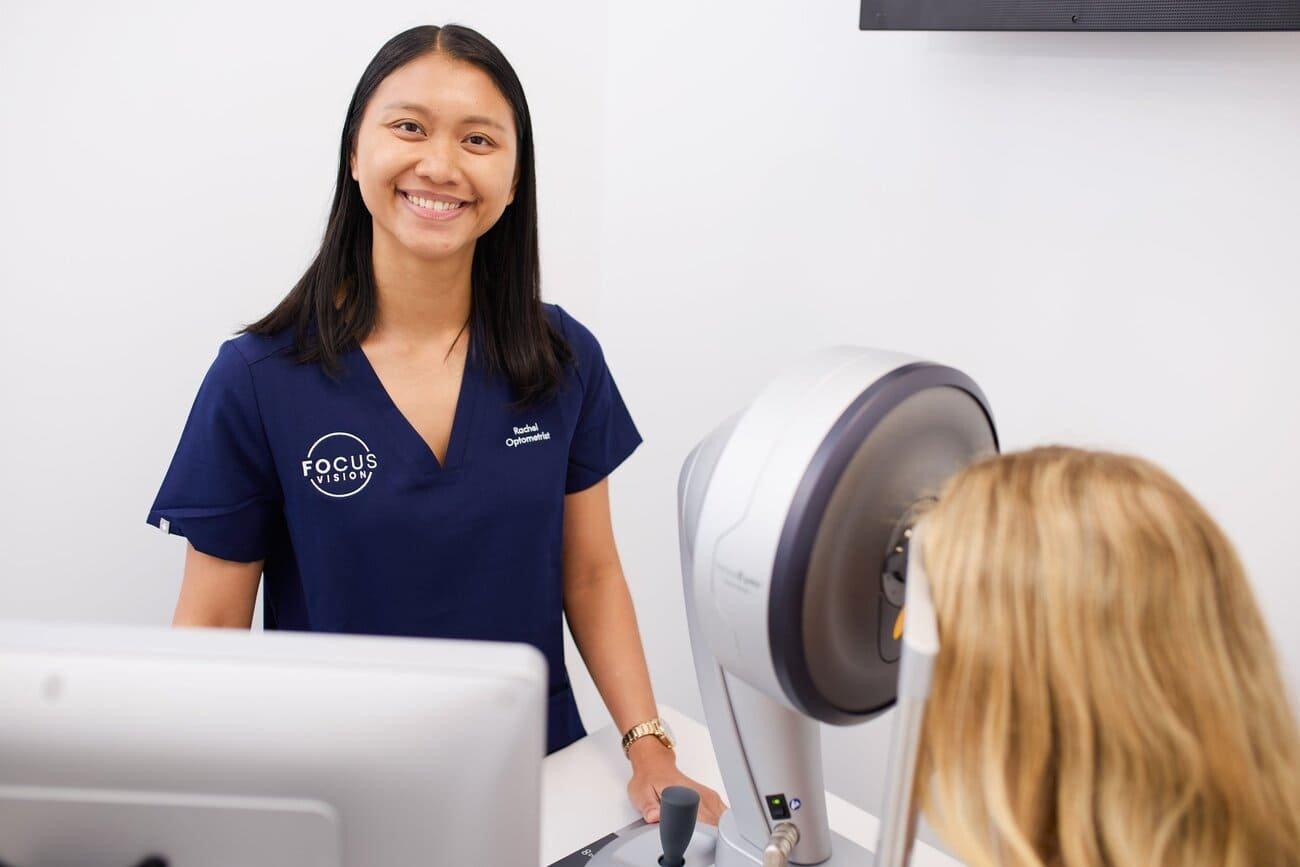
The suitability checklist
| Requirement | Why it matters |
|---|---|
| Age 18 or over | Eyes are still changing in childhood and the teens (FDA). At Focus Vision, LASIK is usually performed between 18 and 55; an implantable contact lens is usually from 21 (FDA, EVO ICL). |
| Stable prescription for at least a year | If your prescription is still changing, the result may not last (FDA). |
| Healthy eyes | Eye conditions such as glaucoma or a cataract affecting your vision need to be assessed first (AAO). |
| Corneas thick and regular enough | Laser reshapes the cornea, so it needs enough healthy tissue. Thin or irregular corneas can rule out LASIK (FDA). |
| No condition or medication that affects healing | Including some autoimmune diseases, diabetes and certain medications (FDA). |
| Not pregnant or breastfeeding | Hormonal changes can alter your prescription (FDA). See pregnancy, breastfeeding and laser eye surgery. |
| Realistic expectations | Laser reduces or removes your need for glasses for distance, but almost everyone needs reading glasses from their 40s (AAO). |
Dry eye doesn’t usually rule you out, but it needs treating before surgery, because laser can make it worse for a while. See dry eye and halos after LASIK.
For the conditions that rule laser out, and the alternatives for each, see who should not have laser eye surgery.
What we check at your assessment
Your suitability is decided by measurements, not by a questionnaire alone. At your assessment we:
- measure your prescription carefully, and compare it with previous glasses or records to confirm it is stable;
- map the shape and thickness of your cornea (topography and tomography), to check it is thick and regular enough and to choose the right procedure;
- check the tear film and eye surface for dry eye;
- measure your pupils in dim light;
- examine the health of the whole eye, including the lens and retina; and
- talk through your work, hobbies and expectations, which can change which procedure suits you best.
Your first assessment with our optometrist is free. If laser looks suitable, you then see a specialist surgeon, who confirms your suitability and plans your surgery; the consultation fee is deducted from the surgery price if you go ahead (costs page).
Which procedure might suit you?
Being “suitable for laser” usually means suitable for one of several procedures. Your surgeon recommends the one that fits your eyes:
| Your situation | Often suits | Learn more |
|---|---|---|
| Short-sighted, long-sighted or astigmatism, with healthy corneas of normal thickness | LASIK or Ray Tracing LASIK | Laser eye surgery |
| Short-sighted, with or without astigmatism, and keen to avoid a flap | CLEAR lenticule extraction | CLEAR |
| Thinner corneas, or a job or sport with a risk of eye injury | Surface laser (TransPRK) | PRK, TransPRK and ASA |
| A high prescription, or corneas too thin for laser | Implantable contact lens (ICL) | ICL vs laser for high prescriptions |
| Mid-40s or older, needing reading glasses | Laser blended vision, or lens replacement | How to get rid of reading glasses |
| Usually from your 50s or 60s, or with early lens changes | Refractive lens exchange | RLE guide |
For how the laser procedures compare, see types of laser eye surgery, and for every option side by side, which eye surgery is best for me?
What results can I expect?
For people who are suitable, modern LASIK results are very good: in a large review of published studies, more than 99% of eyes achieved 20/40 vision or better without glasses, with the majority reaching 20/20 or better (Sandoval et al., 2016). Results vary from person to person, which is why careful selection matters. For surface laser, see the TransPRK results published by Dr David Gunn and Rebecca Cox. If a small prescription remains once your eyes have settled, enhancements are free for two years under our enhancement policy.
Age: is there an upper limit?
At Focus Vision, LASIK is generally suited to people aged about 18 to 55, and your options change with age. Laser corrects the cornea, but from your mid-40s the natural lens inside the eye loses its ability to focus up close, and later in life it clouds into a cataract (AAO). That is why, from around your 50s, lens replacement is often the better long-term choice. See LASIK age limit.

Next steps
- Take the free two-minute laser suitability test.
- Book a free optometrist assessment, or call (07) 3239 5005 or email hello@focusvision.com.au.
- If laser looks suitable, see a specialist surgeon to confirm it and plan your treatment.
References
- U.S. Food and Drug Administration. When is LASIK not for me? fda.gov/medical-devices/lasik/when-lasik-not-me
- American Academy of Ophthalmology. LASIK: laser eye surgery. EyeSmart. aao.org/eye-health/treatments/lasik
- U.S. Food and Drug Administration. EVO/EVO+ Visian Implantable Collamer Lens (EVO ICL) for myopia, PMA P030016/S035 approval, 25 March 2022. accessdata.fda.gov/cdrh_docs/pdf3/P030016S035A.pdf
- Sandoval HP, Donnenfeld ED, Kohnen T, et al. Modern laser in situ keratomileusis outcomes. J Cataract Refract Surg. 2016;42(8):1224-1234. pubmed.ncbi.nlm.nih.gov/27531300