
What Does 6/6 Vision Mean?
You’ve probably heard people talk about “20/20 vision” in movies, and then noticed your Australian optometrist writes something different: 6/6. If you’ve ever wondered what these numbers actually measure — and whether 6/6 means your eyes are perfect — here’s the plain-English explanation.
The eye chart, and what it’s really testing
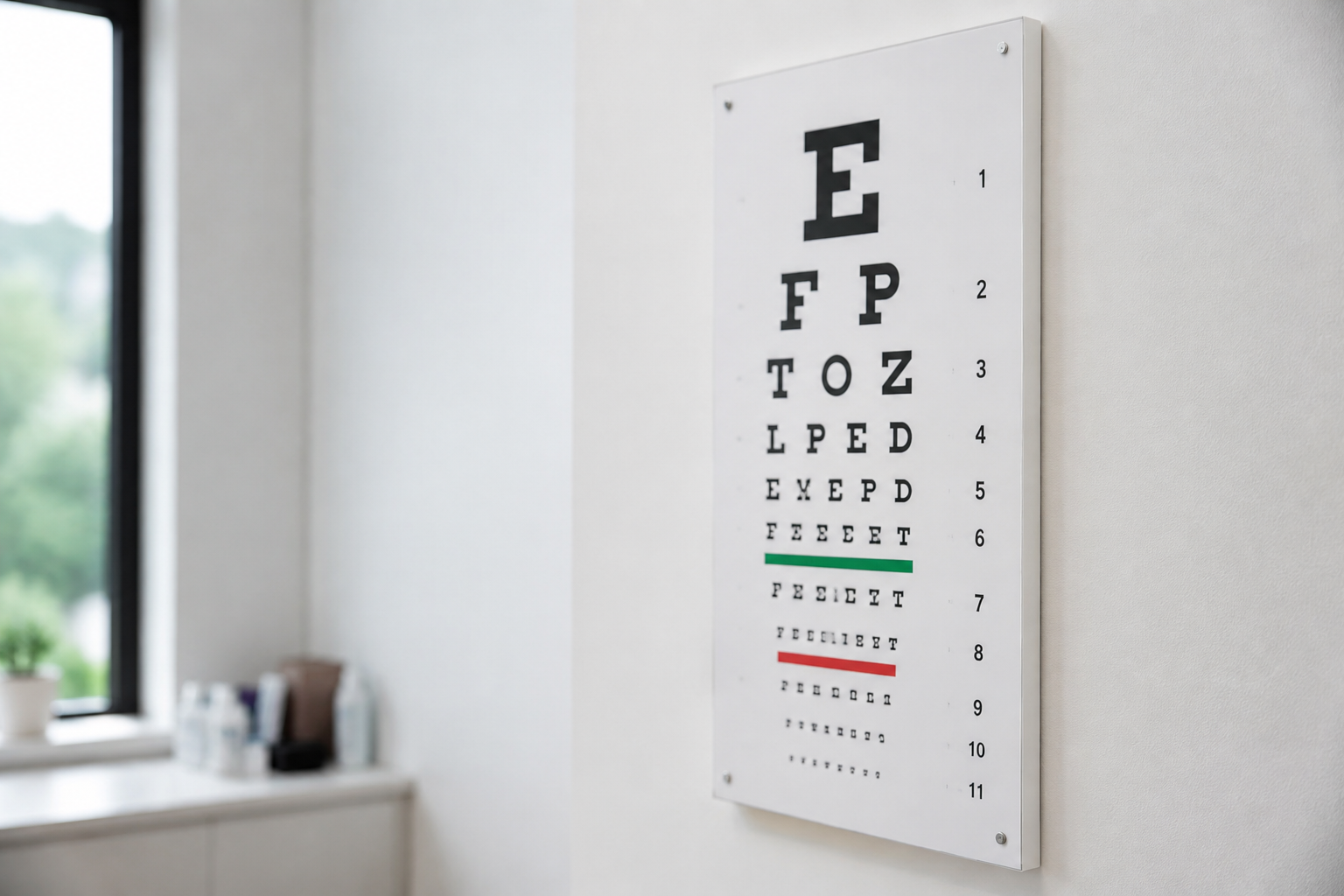
The letter chart on the wall of every optometry practice is called a Snellen chart, and it measures one specific thing: visual acuity, which is the sharpness of your central vision at distance. It doesn’t measure your peripheral vision, colour vision, depth perception or how well you see at night. It answers a single question — how small a detail can you resolve from a set distance?
In Australia and most of the world, that distance is six metres. That’s where the first number comes from.
Breaking down the fraction
6/6 is a comparison between you and a reference standard.
The top number is your testing distance: six metres. The bottom number is the distance at which a person with standard vision could read the same line you just read. So, 6/6 means that at six metres, you read what a standard eye reads at six metres. Your acuity matches the reference standard — this is what’s considered normal sharpness.
If you have 6/12 vision, you need to be at six metres to read what a standard eye could read from twelve. Detail has to be twice as close (or twice as large) before you can resolve it. 6/60 — the big letter at the top of the chart — means you read at six metres what a standard eye reads from sixty.
The American “20/20” is exactly the same measurement expressed in feet: twenty feet is roughly six metres. 6/6 and 20/20 are the same thing.
Is 6/6 “perfect vision”?
Not quite — and this is the most common misunderstanding. 6/6 is the standard for normal visual acuity, not the ceiling. Plenty of people, particularly younger people, can read a line or two beyond it, achieving 6/5 or even better (Elliott et al., 1995). Sharpness also isn’t the whole story of good vision: contrast sensitivity, how your eyes work together, and the quality of your night vision all shape how well you actually see the world.
It’s also worth knowing that 6/6 tells you nothing about eye health. An eye can read the 6/6 line while early cataract or other changes are developing quietly, which is why a proper eye examination involves much more than reading letters.
Why can’t I see 6/6 without glasses?
For most people the answer is refractive error — the eye’s focusing system doesn’t land light precisely on the retina. Short-sightedness (myopia), long-sightedness (hyperopia) and astigmatism all blur the image before it reaches the retina, dropping your unaided acuity below 6/6 even though the eye itself is healthy. That’s why glasses, contact lenses or refractive surgery can restore sharpness: they correct the focus, and the healthy eye behind it does the rest.
This distinction matters when you’re thinking about vision correction. Laser eye surgery and lens-based procedures treat refractive error — the focusing problem — which is precisely why so many people with glasses or contacts can achieve excellent unaided vision after treatment. How much improvement is possible depends on your individual eyes, which is what a refractive assessment works out.
What your eye test numbers mean in practice
A few common results translated: 6/6 means normal sharpness. 6/9 or 6/12 means mildly reduced acuity — often correctable with the right prescription, and 6/12 is around the minimum standard (in your better eye, with correction if worn) for an unconditional private driver’s licence in Australia (Austroads). Worse than 6/60 in the better eye with correction (or a visual field of no more than 10 degrees radius) falls into the definition of legal blindness used for some purposes in Australia (AIHW).
If your numbers have changed since your last test, that’s worth investigating rather than ignoring — vision that keeps drifting usually has an identifiable, and often treatable, cause. Book an assessment with Focus Vision.
References
- Austroads. Assessing Fitness to Drive (AP-G56): Vision and eye disorders. austroads.gov.au
- Australian Institute of Health and Welfare. A guide to Australian eye health data. aihw.gov.au
- Elliott, Yang, Whitaker. Visual acuity changes throughout adulthood in normal, healthy eyes: seeing beyond 6/6. Optom Vis Sci. 1995 (March). pubmed.ncbi.nlm.nih.gov/7609941
- Keratorefractive Lenticule Extraction Using the Ziemer FEMTO LDV Z8 Platform (CLEAR): One-Year Results. J Refract Surg. 2024. doi:10.3928/1081597X-20241016-01 (PubMed 39530987). journals.healio.com/doi/full/10.3928/1081597X-20241016-01
- American Academy of Ophthalmology. What Does 20/20 Vision Mean? EyeSmart. aao.org